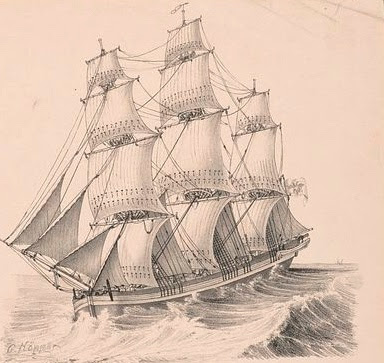
The Convict Ship, Chapman, Paranoia and Mutiny

The convict ship Chapman departed Cork, Ireland, with 200 male convicts on board, 15 March 1817.

Commanded by John Drake and surgeon Alexander Dewar, the Chapman was guarded by the the 46th Regiment of Foot.

The Chapman according to historian marjorie Barnard, was "uneasy" from the first, and Captain drake and Surgeon Dewar decided to keep the convicts in double irons. 

On 25th of March, a sentry reported that the convicts were picking the locks, but guards found all quiet.

On April 25, convicts escaped on deck and were rushing the ship. The crew was put under arms and a number of convicts and suspected seamen were punished. 

Four days later, Michel Collins, an informer, claimed that there was a plot for the convicts to seize the ship and sail to America. 

Arms were piled on the deck in readiness, and the convicts confined between decks. 
It was dark when the ship's cook felt the starboard fore shuttle lift under him, and he raised the alarm that the convicts were forcing the hospital bulkhead. 

Opening fire, 3 convicts were killed, and 22 wounded, but the surgeon fearful, did not attend to the injured until morning. 

Punishment was swift and convicts were put on half rations, and 70 to 100 chained overnight to an iron cable in the prison. Four lengths of chain were passed over each hatch, and threats to suffocate the convicts were made.

Punishments were inflicted for coughing, speaking Irish and rattling chains.

On 30th of April, guns were fired down the hatches, and two killed and four injured. 
Paranoia increased, and soldiers and seaman suspected each other, leading to two seamen being killed after shooting broke out again. 

On May 24, thirty more were wounded. The rest were starving. The ship arrived in Sydney on 20 July 1817.

Read More


A History of Australia (1962), by Marjorie Barnard


1622: Australia's First recorded Shipwreck

Australia's first recorded shipwreck occurred in 1622 when the English ship Tryall, under the command of John Brooke, ran into a reef off the north-west coast of Western Australia, now called Tryal Rocks.

The ship had departed Plymouth on its maiden voyage for Batavia (now Jakarta) when tragedy struck.
45 people escaped. Brook, his son, and 9 others escaped in a skiff. While Thomas Bright and 35 others set off for Batavia in a longboat.

Left to perish on the wreck were 93 people, who were never seen again.
Thomas Bright blamed Brooke's poor navigation and failure to post a lookout for the loss of the ship and her crew. Bright also accused Brook of stealing the ship's cargo of silver.

On returning to England, Brooke was given command of the Moone. As this ship left Batavia in February 1625, it was wrecked off the coast of Dover, with the loss of 50,000 pounds in treasure.

The wreck site was located by the Fremantle-based Underwater Explorer's Club in 1969.

In 1971, another examination of the wreck site found the ship divided into two main sections.

At the site, six cannons and up to eight anchors consistent with the period were recorded, but no definitive means to identify it as the Tryall. 

The Western Australian Shipwreck Galleries at Fremantle has displayed recovered items from the wreck, including a large iron cannon
The Western Australian Shipwreck Galleries at Fremantle has displayed recovered items from the Tryall wreck, including a large iron cannon.

WA Shipwrecks Museum: Cliff Street, Fremantle, WA, 6160

What Happened When Captain Cook Landed on the East Australian Coast?

Captain James Cook FRS (7 November 1728 – 14 February 1779) was a British explorer, cartographer and British naval officer, famous for his three voyages of discovery.

1768–1771: Cook's First voyage on HMS Endeavour. In May 1768, Cook was promoted to the rank of lieutenant and given command of the bark Endeavour on a joint Admiralty-Royal Society expedition to the Pacific.

Not only would Cook observe the Transit of Venus across the face of the Sun, he was given secret orders to search for the unknown Great Southern Continent. This was a trip into the unknown.

The second page instructs Cook "with the Consent of the Natives to take possession of Convenient Situations in the Country in the Name of the King of Great Britain". But "if you find the Country uninhabited, you are to take possession of it for His Majesty ... as First Discoverers and Possessors".

Legends of Terra Australis Incognita—an "unknown land of the South"—date back to Roman times.

Cook never found "Terra Australis" – which was thought to cover the entire southern hemisphere but the continent he did find led to the first penal colony in Australia, established in 1788.  

The first known landing in Australia by Europeans was in 1606 by Dutch navigator Willem Janszoon on Australia's northern coast, when he charted about 300 km of coastline. 
19th-century artist impression of the ship Duyfken in the Gulf of Carpentaria
Janszoon and his crew travelled along 350 kilometres (220 mi) of coast, from 5° south to 13° 45' south, but his ship logs of the ship Duyfken recorded:

that vast regions were for the greater part uncultivated, and certain parts inhabited by savage, cruel black barbarians who slew some of our sailors, so that no information was obtained touching the exact situation of the country and regarding the commodities obtainable and in demand there.

The Dutch, pragmatic people, saw no benefit in Australia in this age of colonisation by European powers.

Captain Cook on the Endeavour landed fourteen times on the East Australian Coast. 

19 April 1770: The east coast of Australia was sighted.
The Endeavour, 1770
Cook only landed once in what is now New South Wales. This was at Botany Bay. The First Fleet again landed here 18 years later.

Sunday 29th April 1770: Cook and his crew did not make a camp at Botany Bay (Ka-may). They lived on the ship for the 8 days they stayed there. They fished for food, explored, obtained water and collected botanical specimens.

Two men from the Gweagal clan of the Dharawal people appeared on the beach, and Cook and his crew threw gifts and tried to communicate their intention to land. Cook wrote in his journal:
French engraving depicting a family group at Port Jackson, 1824. From FREYCINET (Boisseau, Jacques Messidor, 1794-1848)
“on both points of the bay Several of the natives and a few hutts” and decided to land on “the south shore abreast of the Ship... in hopes of speaking with them”. Accompanied “by Mr Banks Dr Solander and Tupia” the Aboriginal people “all made off except two Men who seem’d resolved to oppose our landing. As soon as I saw this I orderd the boats to lay upon their oars in order to speake to them but this was to little purpose for neither us nor Tupia could understand one word they said... I thou[gh]t that they beckon’d to us to come a shore but in this we were mistaken, for as soon as we put the boat in they again came to oppose us upon which I fired a musket between the two which had no other effect than to make them retire back where bundles of thier darts lay, and one of them took up a stone and threw at us which caused my fireing a second Musquet load with small shott, and altho’ some of the shott struck the man yet it had no other effect than to make him lay hold of a Shield or target to defend himself”.

According to Sir Joseph Banks, “We were conscious from the distance the people had been from us when we fird that the shot could have done them no material harm... We however thought it no improper measure to take away with us all the lances which we could find about the houses, amounting in number to forty or fifty”.

Cook also wrote: "I went myself in the Pinnace to sound & explore the Bay in the doing of which I saw some of the Natives, but they all fled at my approach. I landed in 2 places one of which the People had but just left as there were small fires & fresh Muscles broiling upon them, here likewise lay Vast heaps of the largest Oyster Shells I ever saw". 

He continued: "The Natives do not appear to be numberous neither do they seem to live in large bodies but dispers'd in small parties along by the water side..."

On 6 May 1770, the Endeavour left Botany Bay, sailing north. Cook named an inlet Port Jackson, "wherein there appeared to be safe anchorage". Today this is Sydney Harbour. Read here

18th May 1770: the Endeavour is sailing in the Hervey Bay Region: "The land hereabouts, which is of a moderate height, appears more barren than any we have yet seen on this Coast, and the Soil more sandy, there being several large places where nothing else is to be seen; in other places the woods look to be low and Shrubby, nor did we see many signs of inhabitants". Read here

24 May 1770: Cook came ashore and landed on the beach of Round Hill Creek in the vicinity of the present village of Seventeen Seventy (Bustard bay) in the Gladstone Region, Queensland. They found remains of several small fires and shells but no people.

8 June 1770: A landing was made at Waalumbaal Birri (Endeavour River). They saw no people until 9 July, when Cook “saw Seven or eight of the Natives... and two of them came down upon the sandy point opposite the ship but as soon as I put off in a boat in order to speak with them they run away as hard fast as they could”. 

June 8th 1770. Banks and Hickes went ashore near Magnetic Island, QLD, looking for coconuts but found only cabbage palms.

June 10 1770 (landed at Trinity Bay, named after Trinity Sunday), searching for water. Cook landed with Sir Joseph Banks and Dr. Daniel Carl Solander (a Swedish naturalist from the British Museum). Read here

11 June 1770: Just before midnight on 11 June 1770, the Endeavour ran aground on the Great Barrier Reef off modern-day Queensland. Cook names the area Cape Tribulation and writes in his journal ... "because here begun all our troubles". Read here

Water entered the ship below the waterline faster than the ship’s pumps could clear it. Cannons and other heavy items were thrown overboard,  and a sail was stitched with rope fibres, and coated with tar and straw as a waterproof patch. 
After running aground on the Great Barrier Reef, QLD, the crew of the HMB Endeavour jettisoned 48 tonnes of material over the side (one of six that were aboard the Endeavour)
Cook’s crew and the Endeavour spent seven weeks ashore at Endeavour River. 

The British interacted with the Guugu Yimithirr people who believe the Wahalumbaal birri (Endeavour River) was created by the Mungurru (amethystine python) as he travelled down the river valley to the Walmba muulaarr (Great Barrier Reef) to bathe in the ocean.

Cook offered gifts and food to the Guugu Yimithirr people seeking peaceful relations. 

The first recorded word list of an Australian Aboriginal language was compiled by Cook in the area of the Endeavour River in northern Queensland in 1770. 

On Saturday 4 August, Cook wrote in his journal that a certain animal was, "called by the Natives Kangooroo, or Kanguru". This word, kangaroo, was later brought by members of the First Fleet to Sydney. Read here

Cook left the Endeavour River on 5 August 1770.

Cook and his crew had caught 12 to 15 turtles as food for their voyage home, when they stopped near Cooktown.

On 19th July 1770, according to Cook's diary: "In the AM we were viseted by 10 or 11 of the natives the most of them came from the other side of the harbour River where we saw six or seven more the most of them women and like the men quite naked; those that came on board were very desirous of having some of our turtle and took the liberty to haul two to the gang way to put over the side but being disapointed in it this they grew a little troublesome, and was were for throwing every thing overboard they could lay their hands upon; as we had no victuals dress’d at this time I offer’d them some bread to eat, which they rejected with scorn as I believe they would have done any thing else excepting turtle —" Read here

Sir Joseph bank wrote: "They first by signs askd for One and on being refusd shewd great marks of Resentment; one who had askd me on my refusal stamping with his foot pushd me from him with a countenance full of disdain". Read here

Australia is the only continent where no treaties were made between colonists and the original occupants of the land. 

Negotiating such a treaty would have been impossible, as a separate treaty would have been required with each tribe. 

Aboriginal Australia was never united.

The British did make treaties with other groups. For example, the Treaty of Waitangi in New Zealand in 1840. Maori people spoke the same language, and their society was united under a chiefdom.

James Matra, a midshipman on the Endeavour, later became a diplomat, and it was he who proposed the idea of a colony in New South Wales in August 1783, supported by Joseph Banks. Cook was dead by this time. he was killed by Native Hawaiians, 14 February 1779.


In 1948, John Cade Discovers Lithium for Mania


Argus (Melbourne, Vic. : 1848 - 1957), Tuesday 15 February 1938
In March 1948, Australian psychiatrist John Cade discovered the effectiveness of lithium as a treatment for bipolar disorder. Today, lithium is considered the gold standard treatment for bipolar disorder.

Lithium, which was synthesized in the Big Bang, is found in trace amounts in numerous plants, plankton, and invertebrates, and it competes with other ions such as sodium. 

Before this, the soft drink 7Up, formulated in 1929, was called "Bib-Label Lithiated Lemon-Lime Soda" because it contained lithium citrate. The drink was a patent medicine sold as a hangover cure. Lithium citrate was removed from 7Up in 1948.

After returning from incarceration in Changi Prison during WWII, John Cade became medical superintendent and psychiatrist at the Repatriation Mental Hospital in Bundoora, Victoria, where he theorised that uric acid was a cause of manic behaviour ( "brain gout")
Dr John Cade, Age (Melbourne, Vic. : 1854 - 1954), Wednesday 6 January 1954
Cade thought that the psychotic mental state was caused by a chemical imbalance and that the poison may be evident in the sufferer’s urine as well as the brain.

Cade began to work on the toxic substance uric acid and to use lithium salts, which were known to dissolve uric acid.

Injecting erratic guinea pigs with lithium carbonate solution, Cade found the animals became relaxed.

After testing lithium on himself, Cade began to experiment on some of his patients diagnosed with mania, dementia præcox or melancholia.
John Cade acute unit at Royal Park Hospital, VIC, circa 2003. PD
One patient was described as "a little wizened man of 51 who had been in a state of chronic manic excitement for five years . . . amiably restless, dirty, destructive, mischievous, and interfering". 

After treatment with lithium for a short time, became "more settled, tidier, less disinhibited, and less distractible." The patient continued to improve and was able to return to work.

At the time, it was not known that lithium has a narrow therapeutic window. Too little and it has no effect. Too much can damage the kidneys. 

Several deaths of patients undergoing lithium treatment occurred. But this first effective medication to treat a mental illness led to thousands of people remaining stable on lithium, preventing relapse, mood instability and much suffering.

Cade's discovery in 1949 led to world-wide acceptance of lithium as an effective treatment of mania and depression.

There are various ways that lithium may stabilise mood, such as by inhibiting glycogen synthase kinase 3, and or, inositol phosphatases and reducing excitatory (dopamine and glutamate) and increasing inhibitory (GABA) neurotransmission. 
Herald (Melbourne, Vic. : 1861 - 1954), Tuesday 5 January 1954
In 1976, John Cade was one of the first people to be made an Officer of the Order of Australia.

Quong Tart: Chinese Australian Who Played the Bagpipes

Quong Tart, born in 1850 in China, would become one of Sydney's most famous and beloved personalities and philanthropists.

His story in an interesting one. 

Born in 1850 in a small village of Guangdong province, China, Quong Tart came to Australia in 1859 with his uncle and other miners to the goldfields near Braidwood, NSW.

Quong Tart's uncle found Quong a job at the general store of Thomas Forsyth and his wife at Bell's Creek, some 20 kms from Braidwood, where he learned basic accounting and business practices.

The Forsyth's also taught Quong English, but with the Scottish accent in which they spoke.

Alice and Robert Percy Simpson, who owned land and mining claims in the area, then virtually adopted Quong, who would ride about on a horse with Mr Simpson. 

Quong continued his education with the Simpsons and became a devout member of the Anglican Church.

Robert Simpson gave Quong a land claim, and Quong found gold. 

By the time he was 18 Quong had built a house next to the Simpsons. (Quong employed 200 Chinese and Europeans)
Sydney Mail and New South Wales Advertiser (NSW : 1871 - 1912), Saturday 18 April 1874,
Many Chinese came to Australia during this period, and the cheap and plentiful labour force incited public protests, which escalated into racist opposition. 

Quong, calm of character and fluent in Mandarin and English, was able to navigate European and Chinese ways.

Quong had the dress and manners of an English gentleman, and would preform Scottish songs on his bagpipe.

"Quong could sing Scotch songs, recite Burns
with the proper accent, play Scotch airs on the piano. 
He was naturalised in 1871, and was
the first Chinese to join an Oddfellows' Lodge in New South Wales.
Later he became a Forester and a Freemason."
Richmond River Express and Casino Kyogle Advertiser (NSW : 1904 - 1929), Tuesday 13 February 1912

In 1887, the Simpsons moved to Sydney, and they invited Quong to accompany them.

In 1881, Quong returned to China and set ups a tea trade to Sydney.

He then established a chain of silk stores and tea shops. 

Quong married an English school teacher, Margaret Scarlett, on 30 August 1886. The couple had two sons and four daughters, who were baptised in different denominations to avoid charges of prejudice.
Quong Tart and his wife Margaret Scarlett who was a teacher at Araluen., NSW
Quong Tart's Elite Hall in the Queen Victoria Market Building was formally opened by the Mayor of Sydney in 1898.

In 1889, Quong Tart opened a grand Tearoom with marble fountains and ponds with golden carp at 137 King Street, Sydney.
In December 1889, Quong Tart opened the Loong Shan Tea Giyse at 137 King Street, Sydney, NSW. It was his grandest Tea room, with marble fountains and ponds with golden carp.
Quong Tart's tea rooms were also located at 777 George St, in Moore Park Zoo, and the Haymarket theatre district.

Quong Tart and his family lived in a mansion called "Gallop House" in the Sydney suburb of Ashfield.

On 19 August 1902, Sydney was appalled when Quong Tart was bashed with an iron bar and robbed at his office in the Queen Victoria Building. Frederick Duggan was jailed for 12 years for the crime.

Quong Tart died from pleurisy 11 months later, on 26 July 1903, aged 53.
FUNERAL OF THE LATE QUONG TART, ASHFIELD, JULY 28, 1903, .Sydney Mail and New South Wales Advertiser (NSW : 1871 - 1912), Wednesday 5 August 1903

Japanese Midget Submarines Entered Sydney Harbour

Five large Japanese submarines were positioned 56 kilometers north-east of Sydney Heads on 29 May 1942.

The Japanese sent a reconnaissance aircraft at 3.00 am the next day and reported "battleships and cruisers" moored in Sydney Harbour.

The next day, five submarines approached within 11 kilometres off Sydney Heads. About 4.30 pm, three midget submarines were released and approached Sydney Harbour.

Sydney outer-harbour defences detected the first midget submarine's entry at about 8.00 pm.

The midget submarine became entangled in an anti-torpedo net suspended between George's Head and Green Point.

Before HMAS Yarroma could open fire, the submarine's two crew activated demolition charges and scuttled their craft.

The second submarine entered Sydney Harbour at about 9.48 pm and headed west towards the Harbour Bridge.

The submarine was fired on by the heavy cruiser USS Chicago, about 200 metres from Garden Island.

The Japanese submarine fired two torpedoes at USS Chicago, with one torpedo going ashore at Garden Island but not exploding.
The unexploded torpedo at Garden Island several days after the attack, AWM
The other torpedo did not hit USS Chicago but instead, sank HMAS Kuttabul killing 21 sailors (19 Royal Australian Navy and 2 Royal Navy).
The wreck of HMAS Kuttabul sits in the waters of Sydney Harbour at Gardens Point after the attack, Sydney, NSW, 1942. AWM. (Kuttabul, a ferry was taken over by the Navy as a depot ship to accommodate sailors in transit to other postings)
The submarine escaped from the harbour, its mission complete.

HMAS Yandra sighted the third submarine at the entrance to the harbour and it was depth-charged (Most depth charges use high explosive charges and a fuse set to detonate the charge).

Four hours later, the submarine entered the harbour again and was depth-charged in Taylor Bay by the Royal Australian Navy. Both crew members killed themselves.

The two submarines recovered were identical, and their remains used to reconstruct a complete submarine.
A Japanese midget submarine which took part in the unsuccessful attack in Sydney Harbour on 31 May 1942 being raised from the bottom of Sydney Harbour, AUST, during a salvage operation. AWM
A week after the midget submarine attack on Sydney Harbour, the two larger submarines returned and bombarded Sydney and Newcastle with their deck guns.  

One submarine shelled Newcastle for twenty minutes until driven off by fire from coastal artillery defenses at Fort Scratchley. Another submarine fired ten rounds into eastern Sydney.
A composite Japanese midget submarine (of HA-14 & HA-21 which came into Sydney Harbour during WWII) at Australian War Memorial, Canberra. Sept 67. Photo by my father.
Visit the Australian War Memorial
The composite submarine was permanently located at the Australian War Memorial in Canberra, ACT.

Australia Transforms from a Convict Colony

Edward Hargraves is credited with discovering the first payable goldfields in 1851 at Ophir near Bathurst, NSW. However, surveyor James McBrien had noticed gold particles by the Fish River east of Bathurst in 1823.
Edward Hargraves (October 7, 1816 – October 29, 1891) was famous for starting the Australian gold rush. in 1851
The Australian authorities were aware of gold being found but scared of rebellion, unrest and crime waves that may result from the convict population striking it rich.

After the Ophir gold finds, one of the biggest gold rushes in history occurred.

Between 1851 and 1861, about 500,000 people came to Australia from many places around the world, hoping to strike it rich.
Gold miners on minehead, Gulgong [?], New South Wales, ca. 1872, SLNSW
Australia was rapidly transformed from a convict colony to a place of growing industry, expanding population and increased wealth. Gold became Australia’s largest export.

For thousands of European migrants, the gold rush was a chance to break free of a rigid class system: the opportunity for economic prosperity and social mobility. Chinese prospectors mostly wished to find great wealth and return to China.
Simmons's miners' office, mining and law agent, public accountant and greengrocer (next to Chinese boarding house, Gulgong), American & Australasian Photographic Company
The Gold Rush had severe impacts on the lives of Aboriginal people. As Aboriginal people used stone tools and did not have an “iron age” or “bronze age”,  gold was useless to them.

For Aboriginal people, the physical environment was created and shaped by the actions of spiritual ancestors as they travelled across the landscape. Each person belonged to a territory and clan group and had spiritual connections and obligations to that country.

The hoards of men arriving from around the world, digging up the sacred lands, must have been distressing and confusing for Aboriginal people. 

However, some Aboriginal people became very successful during the various gold rushes. Kitty Pluto, born on Kandju country, discovered gold in 1915 on the land, which became the township on the Batavia Goldfield in the 1930s and was officially named Wenlock in 1938.
Chronicle (Adelaide, SA : 1895 - 1954), Thursday 18 July 1940
For nearly two years Kitty was the
only women, black or white, on the
lonely goldfield, and she became some
thing of a local heroine because of the
way she worked on the claim. Almost
very day from daylight to dark she
toiled — wielding a pick and shovel
underground, turning the windlass for
lifting heavy buckets of ore from the
nine, and washing dirt.
Chronicle (Adelaide, SA : 1895 - 1954), Thursday 18 July 1940
Kitty Pluto, photographed on or about the place where she picked up the first piece of gold which led to the development of the present workings at Lower Camp Batavla. Queenslander (Brisbane, Qld. : 1866 - 1939), Thursday 28 January 1932
Another Aboriginal, also with a planetary name, is Jupiter Mosman, who, as a 12 year old boy, was with a small group of prospectors, including Hugh Mosman, James Fraser, and George Clarke, when their horses bolted after a flash of lightning.

 Jupiter found both the horses and a nugget of gold in a creek as he searched for the horses.

Ten major gold reefs were eventually mined at the town that became Charters Towers in Far North Queensland.
The above photograph of the late JupiterMosman was taken only a few months prior to his death at Eventide Home, Charters Towers, in December. 1945. Northern Miner (Charters Towers, Qld. : 1874 - 1954), Thursday 18 February 1954

Star Trek and Captain Cook

Captain Kirk of Star Trek is based on Captain James Cook, the explorer. Furthermore, the USS Enterprise was named after Cook's ship, the...