Systemic Corruption in Queensland Uncovered

The Fitzgerald Inquiry from 1987–1989) into Queensland Police corruption was presided over by Tony Fitzgerald QC with testimony from 339 witnesses.

The inquiry was in response to reports by Phil Dickie in The Courier-Mail about high-level police corruption and a Four Corners television program by Chris Masters, entitled  The Moonlight State, shown on 11 May 1987.

The inquiry Investigated whether members of the Queensland Police force were involved in prostitution, illegal gambling, illicit drugs, and other unlawful activities or misconduct.

Results of the inquiry led to the resignation of Queensland's premier, Joh Bjelke-Petersen, two by-elections, and three former ministers and the Police Commissioner Terry Lewis being jailed.

Police Commissioner Terry Lewis was charged in 1989 with 23 counts of perjury, corruption, and forgery. And to have accepted bribes totalling $700,000 to protect brothels, SP (starting price) bookmakers, illegal casinos, and in-line machine operators and to prevent poker machines being legally introduced in Queensland.
Terence Murray Lewis, Queensland Police Commissioner, CC BY 4.0
Sir Joh Bjelke-Petersen, the Premier of Queensland from 1968 to 1987, was put on trial for perjury relating to evidence he gave to the inquiry, but in 1991, his trial was abandoned with a hung jury.

Bjelke-Petersen resigned as Premier after unsuccessfully trying to have the Governor of Queensland sack all of his ministers after they had deposed him as party leader.

Cabinet Minister Russ Hinze died in 1991, before criminal charges could be levelled against him. However, in December 1989, he had been charged on eight counts of having received a total of $520,000 in corrupt payments (Dunn 1991).
Bjelke-Petersen (left) with minister Russ Hinze, SLQLD. PD
The Fitzgerald Inquiry's recommendations led to the creation of the Criminal Justice Commission, the precursor of the Crime and Corruption Commission.

Colin Dillon, the first Aboriginal policeman in Australia, was the first serving police officer to voluntarily appear before the Fitzgerald Inquiry in 1987 and give first-hand evidence of police corruption.

Voting Rights For Australian Women and Aboriginal People

New Zealand was the first self-governing country to give women the right to vote on 19 September 1893.

On 18 December 1894, South Australia became, the second place in the world, after New Zealand, to give women the vote.

In 1897, Catherine Helen Spence became Australia's first female political candidate when she stood (unsuccessfully) for the Federal Convention held in Adelaide.
Portrait of Catherine Helen Spence in the 1890s
Under the Municipal Corporations Act of 1861, South Australia's female ratepayers, were already enfranchised. Some women had been voting in municipal elections for more than 20 years.

Interestingly, the female descendants of the Bounty mutineers who lived on Pitcairn Islands could vote from 1838.
 
In 1856, 52 years before women's suffrage was achieved in Victoria, Fanny Finch and another unnamed woman, used their status as ratepayers to vote during municipal elections. 

Fanny Finch had been born in London, possibly to free people of African racial heritage, and was raised in a foundling hospital. She arrived in the colony of South Australia in 1837 and later became a businesswoman.
Frances Finch was born Frances Combe in London in 1815.
In the 1850s, the constitutions of Victoria, New South Wales and South Australia gave Aboriginal men the same right to vote as other male British subjects aged over 21.

In other states, laws to deny the vote to Aboriginal and Torres Strait Islander people were enacted by Queensland (1885), Western Australia (1893) and the Northern Territory (1922).

Tasmania granted Aboriginal men the right to vote in 1896.

The Commonwealth Parliament of Australia, passed the uniform Commonwealth Franchise Act 1902, which enabled women 21 years of age and older to vote at elections for the federal Parliament. Aboriginal women who already had the right to vote, could continue to do so.

A report delivered in 1961 found that many Aboriginal and Torres Strait Islander people had been denied the vote due tof discriminatory legislation in the Northern Territory, Western Australia and Queensland.

The Commonwealth Electoral Act 1962 granted all Aboriginal and Torres Strait Islander people the option to enrol and vote in federal elections.

The Aboriginal Tent Embassy began with a beach umbrella on 26 January 1972, a symbol of Aboriginal protest.
First day of the Aboriginal Tent Embassy, outside Parliament House, Canberra, 27 January 1972. Left to right: Billy Craigie, Bert Williams, Michael Anderson and Tony Coorey. PD
King Abdullah of Saudi Arabia only granted women the right to vote in 2011.

Dame Mary Gilmore: Scott Morrison's Great Great Aunt

Born on 16 August 1865, near Goulburn, NSW, Dame Mary Gilmore, née Cameron, is represented on the $10 banknote.

Gilmore became a celebrated public figure, popular writer, socialist and poet.

During her childhood, Gilmore's family moved about as her father's job as a station manager and carpenter, required.

In January 1883, Gilmore became a pupil teacher at the Superior Public School, Wagga Wagga.

One of the most severe economic Depressions in Australia's history occurred in the 1890s, bringing mass unemployment, misery and poverty and likely shaped Gilmore's political views and activism.

Gilmore claimed to have a relationship with Henry Lawson (about 1890), that would become one of the greatest influences upon her work, and there was an unofficial engagement.

In 1897, Gilmore married William Alexander Gilmore and, the following year, gave birth to their only child, William Dysar.

From 1908, Gilmore became editor of the women’s section of The Australian Worker until 1931.
Sunday Sun (Sydney, NSW : 1903 - 1910), Sunday 31 July 1910
Mary Gilmore, Advocate (Melbourne, Vic. : 1868 - 1954), Thursday 25 January 1923
In 1928, Gilmore was a founding member of the Fellowship of Australian Writers.

In 1932, Gilmore wrote a haunting poem, The Waradgery Tribe, which, though heartfelt, is contrary to the views of today. During her childhood, Gilmore also lived with Aboriginal people for a time. She wrote later, in 1952:
Tribune (Sydney, NSW : 1939 - 1991), Wednesday 9 July 1952
For her services to literature, Mary Gilmore was appointed a Dame Commander of the Order of the British Empire on 1 February 1937.

Gilmore, who often romanticised the working class and Aboriginal life, was also an ardent nationalist,  evidenced by her poem, No Foe Shall Gather Our Harvest

The poem, published in The Australian Women's Weekly on 29 June 1940, is said to have "proved a remarkable morale booster in the tense days of the Japanese threat to Australia in 1942". (The Oxford Companion to Australian Literature, 2nd edition, p581)

Gilmore commenced a regular column, "Arrows", for the Tribune in 1952.
Tribune (Sydney, NSW : 1939 - 1991), Wednesday 7 September 1955
DAME MARY GILMORE by WILLIAM DOBELL William Dobell, outstanding Australian artist, painted this portrait of Dame MaryGilmore, grand old lady of Australian letters, Australian Women's Weekly (1933 - 1982), Wednesday 25 September 1957
In 1961, Gilmore was honoured by the Australian Trade Unions as May Queen for the May Day procession.

In 1962, when Gilmore died at age 97, two and a half years before the birth of her great-great nephew, Scott Morrison, who would be a future Australian prime minister, she was given a state funeral. Her likeness also appears on the Australian ten-dollar note.

Borrow, Old days, old ways: a book of recollections by Gilmore, Mary, 1865-1962, free here (Internet Archive)                                                                                                        

The Watson Government: First Labour Government in The World

John Christian Watson (1867-1941), became Australia's third Prime in 1904 and formed the world's first Labor Government.

Watson, born in Chile, of New Zealand parents, moved to Sydney in 1886 and became active in the labour movement.

Watson was one of the founders of the Labor Electoral League of New South Wales (Labor party) and was the party's campaign director at the 1891 general election. 

On 29 Mar 1901, Watson was elected as Member of Parliament for the seat of Bland (NSW), and became a founding member of the ALP caucus.

On 8 May 1901, Watson was elected leader of Australia's Labor Party (1901-7).
John Christian Watson (born Johan Cristian Tanck; 9 April 1867 – 18 November 1941)
Alfred Deakin resigned as prime minister, 27 Apr 1904, and the same day, the Governor-General, Lord Northcote, summoned Watson to form Australia’s first federal Labor government. 

At the age of 37, Watson was Australia’s youngest prime minister.

Watson resigned as prime minister, defeated over the Conciliation and Arbitration Bill and unable to command a majority in the House of Representatives, 15 Aug 1904.
Queensland Country Life (Qld. : 1900 - 1954), Wednesday 1 March 1905
Chris Watson held office for only four months, but he holds a place in history by leading the world's first national Labour government.

1854: The Telegraph Connection Between Melbourne and Williamstown

A telegraph is a device for transmitting and receiving messages over long distances. This technology transformed communication, and information could travel much faster.

Australia's geographic isolation from the rest of the world, came to an end.

Australia's first telegraph line, sponsored by the Victorian Government, was constructed between Melbourne and Williamstown in 1853 and 1854.

By December 1854, the telegraph line to Geelong was complete, and the first message sent news to Melbourne about the Eureka Stockade. 

Connections to Queenscliff and Port Melbourne (January and July 1855) allowed passing information about ships entering the harbour and arriving at port.

In December 1856, telegraph connections to the gold-mining centres of Ballarat and Bendigo were complete.

Victoria had an extensive telegraph network by 1857.
Age (Melbourne, Vic. : 1854 - 1954), Thursday 15 April 1858
The Adelaide to Melbourne connection begun in April 1857, was completed in July 1858. 

A telegraph line connecting Hobart and Launceston was complete in 1857. And also other lines to George Town in March 1858, and from Hobart to Mt Nelson in July, and Low Head in October 1858. 
 
In early 1859, the Tasmanian and Victorian Governments agreed to share the costs of a a submarine cable linking Tasmania to the mainland. Due to undersea faults, it was abandoned by January 1861.

The Sydney to Liverpool telegraph line in NSW opened on 30 December 1857.

The Liverpool line was extended to Albury in October 1858. 
Electric Telegraph Office, Sydney, NSW, 1860] SLNSW
Soon after Queensland separated from New South Wales on 1 June 1860, a line from Brisbane to Toowoomba commenced. The first stage completed to Ipswich in April 1861.

The first messages from Brisbane to Sydney between Governors Sir John Young (NSW) and Sir George Bowen (Qld) occurred on 9 November 1861.

In Western Australia, the Perth to Fremantle link opened on 21 June 1869. A link to Albany was completed in 1870.

In 1870, Australia was linked directly to the British telegraphic cable system by a cable from Singapore via Java to Port Darwin.
Workers on the Overland Telegraph Line, Southport, Port Darwin, Northern Territory, approximately 1870 / Samuel Sweet, NLAUST
The Overland Telegraph, stretching more than 3,000km from Adelaide to Darwin, was connected August 22, 1872.
Planting the first telegraph pole, near Palmerston (Darwin) on 15 September 1870. Among those present were: Mr Palmer, Mr Burton, Dr Furnell, Dr James Millner, D.D. Daly, Miss Douglas, Mr & Mrs W.T. Dallwood, Willie Douglas, A.T. Childs, Captain & Mrs Douglas, F.W. Dallwood, Miss Douglas, W. McMinn, Miss B. Douglas, Mr James Darwent, J. McKinlay, Mr Grey, Mr E. Holthouse, Mr Davis, Mr Paquelin. Time: 3.00pm. Peter Spillett Collection - Northern Territory Library. Image number PH0238/0383. PD
Port Darwin became the terminus for the Overland Telegraph in 1870
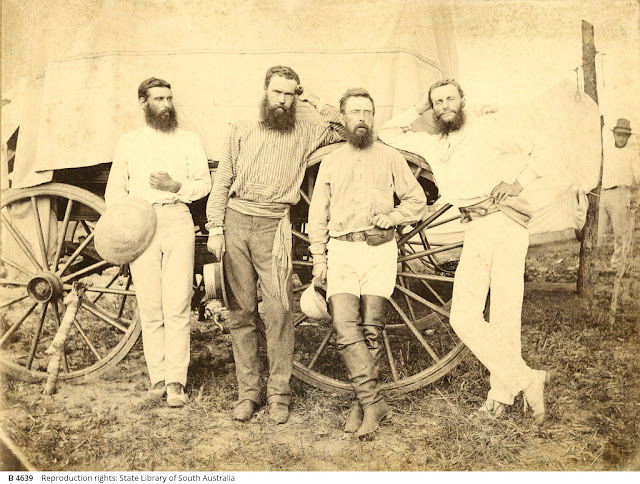
Overland Telegraph Construction party. L-R John A.G. Little, R.C. Patterson, Charles Todd and A.J. Mitchell. 1872, SLSA
The Cape York Telegraph Line was completed in 1887 and stretched from Laura to Thursday Island.
A TELEGRAPH CONSTRUCTION PARTY. LEAVING MOUNT MAGNET FOR LAWLERS. Western Mail (Perth, WA : 1885 - 1954), Saturday 10 March 1900
A telegraph cable across the Pacific between Canada and Australia via Fiji and Norfolk Island was complete in October 1902.

The First Aboriginal Author to Be Published

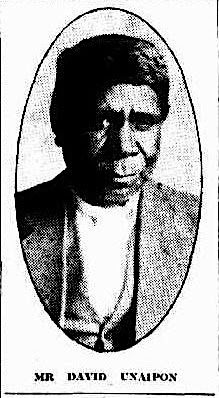
INVENTOR AND STUDENT ABORIGINE ATTRACTS Mr. David Unalpon, the Australian
aborigine from the Point Macleay Mission Station, South Australia, whose photograph Is here, produced, Is on a visit to Melbourne.Herald. (Melbourne, Vic. : 1861 - 1954), Monday 13 July 1914
David Unaipon, the man on our $50 note, was the first Aboriginal author to be published in the 1927, when his book of Aboriginal legends was published

However, according to the South Australian Museum historian, Unaipon ".. signed a book contract with Angus & Robertson, but they baulked at his blend of fairy tale, popular science, Aboriginal legend and Christian morality." (1.)

Angus and Robertson then sold the copyright of the stories to William Ramsay Smith.

In 1929, William Ramsay Smith published Myths & legends of the Australian Aboriginals (1930), as told to Smith by David Unaipon, who was Smith's assistant.
  
Later research showed that Unaipon had sold the text to finance his own work. (Volume 85 Item 2: Angus & Robertson correspondence files from Lilian Irene Turner to Arthur Styles Vallack, 1896–1931)

David Ngunaitponi, known as David Unaipon (1872-1967), was born on 28 September 1872 at the Point McLeay Mission, South Australia, a member of the Ngarrindjeri people, where he was introduced to popular science by his teacher, Walter Hutley.
Kapunda Herald (SA : 1878 - 1951), Tuesday 22 May 1894
Unaipon left school at 13 to work for C.B. Young, patron of the Aborigines’ Friends’ Association, who encouraged Unaipon's interest in literature, philosophy, science and music.

From 1924 onwards, Unaipon wrote many articles for the Sydney Daily Telegraph.

Unaipon defied stereotypes in many ways. Described as urbane and self-possessed, he had a formal manner, was very particular with his use of language and was cultured and dignified.

He was also an inventor, evangelical preacher, political activist, orator and singer. 

Unaipon also assisted various inquiries and commissions into Aboriginal welfare and treatment.
Dungog Chronicle : Durham and Gloucester Advertiser (NSW : 1894 - 1954), Friday 23 November 1923
DAVID UNAIPON, Adelaide's best known native, demonstrates how to throw a boomerang. He spends much time in the parklands teaching schoolchlldren the art. He thinks boomerang throwing should he a national sport. Barrier Miner (Broken Hill, NSW : 1888 - 1954), Saturday 1 October 1932
News (Adelaide, SA : 1923 - 1954), Friday 21 May 1937
News (Adelaide, SA : 1923 - 1954), Saturday 13 June 1953


Treacherous Bass Strait and One of The Worst Shipwrecks in Australian History

The three-masted barque, Neva, made two voyages transporting convicts to Australia.

On her second voyage, the Neva departed Cork, Ireland, on 8 January 1835 for Sydney, carrying 150 female convicts with 33 children and nine free women (probably wives of convicts).
Three-masted ship
The ship's lookout called out that dreaded warning, “breakers ahead!” and about 5 a.m. on 13 May 1835, Neva hit a reef near King Island in Bass Strait.

As the ship filled with water and began to break up, 200 panic-stricken women and children came up on deck and raided the rum stores.

The women were soon hopelessly drunk, and as the ship became swamped with water and collapsed, many were unable to save themselves. 

The deck then broke away from the rest of the ship and broke into two sections, with the remaining survivors on these raft-like floating structures.

The survivors were carried toward the shore of King Island.
One raft grounded and broke up, and of the about 20 people on board, only three, including Captain Peck, made it ashore.
 
The other raft, with 19 aboard, drifted easily to shore. 

A keg of rum also rolled ashore providing the survivors with small comfort as they huddled together for the night.

The horrors were not yet over. By morning, four women and a boy had died from exposure, and then two more women died, leaving only 15 survivors. 

 Only 95 bodies were found and buried in shallow graves.
Sydney Gazette and New South Wales Advertiser (NSW : 1803 - 1842), Thursday 16 July 1835

Star Trek and Captain Cook

Captain Kirk of Star Trek is based on Captain James Cook, the explorer. Furthermore, the USS Enterprise was named after Cook's ship, the...