Star Trek and Captain Cook

Captain Kirk of Star Trek is based on Captain James Cook, the explorer.

Furthermore, the USS Enterprise was named after Cook's ship, the HMS Endeavour. 

The mission of the Starship Enterprise was “to boldly go where no man has gone before”. These words were inspired by Cook’s journal entry, “ambition leads me … farther than any other man has been before me”. 

The original television series creator of Star Trek, Gene Roddenberry, a great admirer of James Cook, also based Spock on Cook's scientist companion, Sir Joseph Banks. 

However, whilst Spook was rational and emotionless, Banks became one of England's wealthiest men and was described in 1776 as "a wild eccentric character" who obviously, still dreamed of his "voyage to Otaheite" (Tahiti). 

It was in Tahiti that Banks gained his reputation as a libertine. Cook is known as a responsible man of laconic understatement.
Captain James Cook, Public Domain

Groundbreaking Australian Soap Operas

A soap opera is usually defined as a long-running radio or television serial with the same cast of characters.

Australia's first successful soap opera was Bellbird, which ran on the ABC from 1967 to 1977.

Set in the small fictional Victorian rural town of Bellbird, the script editor of the show, Barbara Vernon, who lived some of her life in Inverell, N.S.W., said that Bellbird was an amalgam of every small town she and the other writers had known. 

Watching Bellbird today shows us how much time has changed the "typical" country town of Australia.

Number 96, TV series ran from 1972–1977, set in Paddington, NSW, was raunchy, with frontal nudity and exploration of taboo subject matters. 
Gay lawyer Don Finlayson, played by Joe Hasham in Number 96, had the first gay kiss between two men on primetime TV. 

 In 1974, an average of 2.4 million Australians watched each episode (1.).

While today Number 96 is regarded as trailblazing. In 1977, an article in the Tribune wrote:

Number 96, TV's soppiest
soap opera, is finally to die.
Some of us would question
whether it was ever alive, but
that's another issue.

I found its solution in ultra cheap tele for the masses. Cheap
scripts, cheap sets, cheap filming schedules . And just
enough cheap thrills to keep the ratings up.

Another soap with adult content was The Box, which ran from 1974 to 1977, exploring the lives of the people in a fictitious television station, Channel 12. Notably, the scheming bisexual Vicki Stafford (Judy Nunn) kissies a teenager Felicity (Helen Hemingway). 

The Sullivans, which ran from 1976 to 1983, was a quality, critically acclaimed production about a fictional family from Melbourne and the effects of the Second World War.

A 1978 newspaper article wrote: 

For a picture of war trodden Australia,
"The Sullivans" is a must for viewing. It
presents a unique quality of realism both
in setting and dialogue. The characters
grow and while there is much "soapiness"
in this soap opera, it manages to
generate a warm communication between
the cast and the audience. The trouble is
that the programme risks becoming boring. 
(2.)

A Country Practice screening from 1981 to 1994 followed a medical practice in the fictional regional town of Wandin Valley. 
The series was shown in Britain, Eire, Italy, West Germany, the USA, Zimbabwe, Zambia, Malta and Hong Kong. (3.) 

Social, medical and moral issues were explored. For example, nurse Jenny Austin is found HIV positive in a staff health check, and she confronts her fiancé.

Other soaps to develop storylines around gay, lesbian characters, and HIV were The Flying Doctors, Blue Heelers, Neighbours and Home and Away.

Neighbours began in 1985 revolving around the domestic lives of people who live and work in fictional Erinsborough.

A newspaper article in 1988 said:

Australian television soap opera Neigh
bours has doubled its daily audience to
14 million in three weeks and is now the
third most popular program on British
TV
...... (4.)

Another article wrote:

The show operates
on two levels - establishing a social
ideal to be strived for, while
simultaneously appealing to
viewers' sense of their own world.
Some sociologists have seen the
programs 'realism' as a source of
success. Yet the scenario it portrays
is far from real.
A 'perfect' world
Neighbours is set in an exclusively
Anglo-Celtic world, the mythical
suburb of Erinsborough. It tells the
continuing story of a handful of
lower middle class families in
Ramsay Street,
The Neighbours community is
idealised and self contained.
(5.)

Feminist Germaine Greer has said on a discussion of Shakespeare: “He exists to call into question all our certainties. He’s not writing scripts for (UK soap) EastEnders or Neighbours. He’s actually making you think”.

Neighbours helped launch the careers of Kylie Minogue, Jason Donovan, Natalie Imbruglia, Alan Dale, Margot Robbie, Russell Crowe, The Hemsworth brothers, and Holly Valance.

Uncouth Louts: Larrikins, Mug Lairs and Yahoos

Older generations of Australians generally didn't approve of waste, showoffs and vulgar flamboyance.

Virtues such as temperance, modesty, perseverance and constraint were necessary due to factors such as economic depression, wars, hardship and lack of birth control.

During the convict era, young men associated with jauntily wearing fashionable hats made from the cabbage tree palm (Livistona australis) were labelled Cabbage Tree Mobs.
Colonial Observer (Sydney, NSW : 1841 - 1844), Saturday 29 October 1842
Australian writer Marcus Clarke wearing a cabbage tree hat, 1866
In Melbourne, the word larrikin became popular after police sergeant John Staunton described youths to the magistrate in his Galway brogue, larking about in the street ('larrr a kin').

Ned Kelly, in his 1879 Jerilderie letter, wrote: "It takes eight or eleven of the biggest mud crushers in Melbourne to take one poor little half-starved larrakin [sic] to a watch house".
LARRIKINS. Mr. Longmore.—" QUITE A TREAT—AIN'T IT, YALE?—TO SEE Mr. Vale.—"YES, INDEED; IT MAKES ONE ALMOST WISH TO BOYS ENJOYING THEMSELVES IN THAT HARMLESS MANNER?"BE YOUNG AGAIN." Melbourne Punch (Vic. : 1855 - 1900), Thursday 18 May 1871
Clarence and Richmond Examiner and New England Advertiser (Grafton, NSW : 1859 - 1889), Saturday 23 November 1878
The British-English term "lout" was first recorded in 1596 in the writing of James Dalrymple.

Mug lair also seems to be derived from the British slang word lairy (or leery), meaning "knowingly conceited" for a flashily, showy, rude and socially inappropriate young person (usually male).
Balonne Beacon (St. George, Qld. : 1909 - 1954), Thursday 18 March 1948
In the 1950s, there was a new group of louts. Males were called bodgies, and the females were called widgies. Dressing in a similar way to the British Rocker, an article in the Perth Sunday Times of 1952 claimed that "......bodgies originated in America, but it's only in Australia where they're called bodgies. The word is a term that originated in Sydney, to describe anything "lairy".
Daily Advertiser (Wagga Wagga, NSW : 1911 - 1954), Monday 10 December 1951
Truth (Sydney, NSW : 1894 - 1954), Sunday 18 May 1952,
A hoon, is generally a term of derision for a young bloke who drives too fast. The word originated from rhyming slang, "silver spoon", for someone who lived off immoral earnings.

Crude, loud, or stupid, the word yahoo was coined by Jonathan Swift in "Gulliver's Travels", for an imaginary race of brutish creatures.
Sun (Kalgoorlie, WA : 1939), Sunday 15 October 1939,

A Whole Generation Scarred

Before the the Wall Street crash of 1929 led to a worldwide economic depression, Australia was suffering from falling wheat and wool prices and had borrowed vast sums of money from overseas banks, which needed to be paid back.
Miss Goldstein and Miss John collecting parcels at' Flinders-stree for workless women, Woman Voter (Melbourne, Vic. : 1911 - 1919), Tuesday 23 February 1915
Following the 1929 federal election in Australia, James Scullin's Labor Government, assumed power. 

Not long afterwards, "Black Thursday" (Oct. 24, 1929), the day of the largest sell-off of shares in U.S. history occurred, marking the onset of the Great Depression.

Australia was soon plunged into an era of high unemployment, poverty, low profits, deflation, falling wages and lost opportunities for many.

Strikes and labour unrest increased dramatically.

The big cities were depopulated, with thousands of unemployed men taking to the road looking for work on farms.

Other men walked the "Hungry Mile" along the wharves near Darling Harbour in search of a day’s work. Many faced constant rejection by employers.

Psychological stress increased, resulting in depression, hopelessness, humiliation, domestic violence and child abuse.
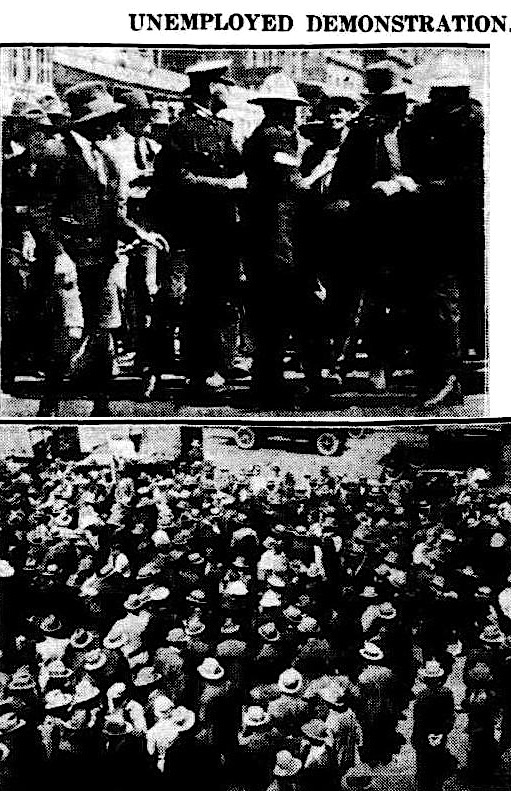
The Premier (Mr. P. Collier) returned from the Eastern States yesterday, and the unemployed held a demonstration outside the Perth station. The Premier, however, had left the train at Mt. Lawley, where he lives. The police made three arrests before the demonstration cleared.West Australian (Perth, WA : 1879 - 1954), Thursday 14 March 1929
Children experienced malnutrition, ill-health, and many lived in over-crowded housing,

Renters faced eviction if they could not pay their rent. And if they had no where else to go, the police might be sent.

Shanty towns developed in various places like: Sydney’s Domain and La Perouse, Melbourne’s Dudley Flats and the banks of the River Torrens in Adelaide.

People lived in tents, makeshift shelters made from flour sacks and scavenged materials. 

In December 1929, the government allocated £1 000 000 from the Federal Aid Roads Agreement for the provision of relief work for the unemployed.
 The result of cutting lawns in Macquarie-street yesterday by men engaged through the Labour Exchange.Sydney Morning Herald (NSW : 1842 - 1954), Tuesday 15 July 1930
Aboriginal people who had been living independently and were now unemployed, were forced to move to government reserves and accept rations.
Unemployed procession, Melbourne, VIC, Newcastle Sun (NSW : 1918 - 1954), Saturday 7 March 1931
In May 1931, the federal Labor government and six state Premiers agreed to a 20% reduction in government expenditure, cuts to wages and pensions, and increased taxation.

In 1932, the Australian economy collapsed, and unemployment reached a peak of 32 per cent. Harship affected many communities.

In late 1933, “sustenance” and “food relief” expanded, as did work for dole schemes. Unemployed women were often denied public assistance.
Scene in Fttzrov, Melbourne), outside a terrace from which 95 unemployed single men were evicted by a sudden coup, planned on military lines, by the police .Their belongings are shown in the street, which they blocked for about 150 yards Sun (Sydney, NSW : 1910 - 1954), Wednesday 9 August 1933
The- inhabitants of Brisbane's - shanty town are nearly all pensioners, QLD. Telegraph (Brisbane, Qld. : 1872 - 1947), Friday 13 January 1933,
On the River Bank, below the Government Buildings in William Street, City, NSW, unemployed have made their homes of bags, slicks, and iron. Telegraph (Brisbane, Qld. : 1872 - 1947), Wednesday 28 February 1934
Many depended on charity or the dole.

A whole generation were scarred by their experiences during the Great Depression.
A CONTRAST. — Above are shown types of dwellings occupied by South Australian natives at a camp at Oodnadatta. Below — Houses such as these and community bathrooms are provided for natives at La Perouse by the New South Wales Government.Mail (Adelaide, SA : 1912 - 1954), Saturday 15 August 1936
Shanty town, Port Kembla, NSW, Sydney Morning Herald (NSW : 1842 - 1954), Friday 21 January 1938

The 1808 Australian Coup D'Etat

On 26th January 1808, 400 officers and men of the New South Wales Corps marched to Government House in Sydney to arrest Governor William Bligh.
Watercolour drawing of First Government House, Sydney, ca. 1809, John William Lewin (1770-1819) 
Bligh was arrested, and the colony was placed under military rule.

This revolt, the Rum Rebellion, remains Australia's only coup d'état.

With a lack of actual money in the colony, rum had become the medium of trade and for goods and services from 1793.

The New South Wales Corps controlled all the trade and paid the farmers in rum for their produce.

Attempts by Governor Hunter to stop the NSW Corp buying all the imported rum, failed.

The Corps' officers simply chartered a Danish ship to bring in a large shipment of rum from India.

Governor William Bligh was appointed in 1805 to break the rum monopoly of the NSW Corps. 

Bligh clashed with Major George Johnston and  the former Lieutenant, now grazier and businessman, John Macarthur. 

The NSW Corp arrived at Government House and supposedly found Bligh under his bed. His daughter, Mary, however, attempted to fight the coup armed with her parasol.
A propaganda cartoon exhibited in Sydney within hours of William Bligh's arrest, portraying him as a coward. The arrest of Governor Bligh, 1808, artist unknown, watercolour drawing, attached to the left hand wall in the image is a sheet with text, "O what can the matter be", Mitchell Library, State Library of New South Wales, Safe 4/5
Bligh remained under house arrest until January 1809.

The military stayed in power for two years until Lachlan Macquarie arrived in Sydney in January 1810, becoming the fifth Governor of NSW.
Lachlan Macquarie attributed to John Opie (1761-1807)
A Walking Tour of O’Connell Town & parts of Bligh’s Terrace, (now all now called Newtown), in the inner-west of Sydney, New South Wales. Here

Anna Bligh, former Queensland Premier, is a descendant of William Bligh, who is famous for the Mutiny on the Bounty and being the 4th Governor of New South Wales.

Read 

That Bligh Girl, by Sue Williams

1791: Fifty Convicts Try to Walk to China From Parramatta

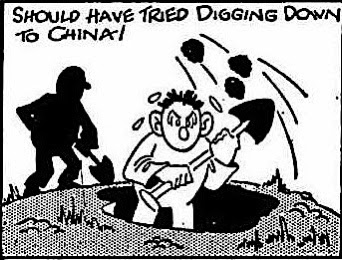
Twenty-one convicts escaped from Port Jackson, who had limited knowledge about Australia and attempted to walk to China. Some died in the bush, and others were recaptured.
Cairns Post (Qld. : 1909 - 1954), Monday 27 April 1936
World's News (Sydney, NSW : 1901 - 1955), Wednesday 22 April 1936

Cumberland Argus and Fruitgrowers Advocate (Parramatta, NSW : 1888 - 1950), Wednesday 4 October 1899

Tenterfield Intercolonial Courier and Fairfield and Wallangarra Advocate (NSW : 1900 - 1914), Tuesday 7 November 1905

1788: The British and Aboriginals Dance Together

Lieutenant William Bradley, a British naval officer and cartographer, compiled a journal which begins in 1786 with the organisation of the First Fleet from Deptford, England, and records the voyage to Australia.
Botany Bay. Sirius & convoy going in: Supply & Agent's Division in the Bay. 21 Janry 1788', Lieutenant William Bradley
Three days after the First Fleet landed in Port Jackson, Sydney Cove, carrying British sailors and convicts, the sailors met Aboriginal people on the beach and Lieutenant Bradley reported, “these people mixed with ours and all hands danced together”.
'View in Broken Bay New South Wales, March 1788', Lieutenant William Bradley (note the dancing figures)

Below are excepts from Lieutenant William Bradley's journal.

29 January 1788

Tuesday, 29th. Landed on a point forming the NW or middle branch, to which we were followed by several of the natives, along the rocks, having only their sticks which they use in throwing the lance, with them. A man followed at some distance with a bundle of lances. They pointed with their sticks to the best landing place and met us in the most cheerful manner, shouting and dancing. The women kept at a distance near the man with the spears. This mark of attention to the women in showing us that, although they met us unarmed, they had arms ready to protect them, increased my favourable opinion of them very much. Some of these people, having pieces of tape and other things tied about them, we conclude them to be some of those people whom the Governor had met here before. These people mixed with ours and all hands danced together.

Our people and these mixed together and were quite sociable, dancing and otherwise amusing them. One of our people combed their hair, with which they were much pleased. Several women appeared at a distance, but we could not prevail on the men to bring them near us.

We had here an opportunity of examining their canoes and weapons. The canoe is made of the bark taken off a large tree of the length they want to make the canoe, which is gathered up at each end and secured by a lashing of strong vine which runs amongst the underbrush. One was secured by small line. They fix spreaders in the inside. The paddles are about 2 feet long in shape like a pudding stirrer. These they use, one in each hand, and go along very fast, setting with their legs under them and their bodies erect and, although they do not use outriggers, I have seen them paddle through a large surf without oversetting or taking in more water than if rowing in smooth water. From their construction they are apt to leak when any weight is in them.

Read the diary here: William Bradley's Voyage to New South Wales edited by Colin Choat

Read, Dancing with Strangers by Inga Clendinnen, (Cambridge University Press, 2005)

Systemic Corruption in Queensland Uncovered

The Fitzgerald Inquiry from 1987–1989) into Queensland Police corruption was presided over by Tony Fitzgerald QC with testimony from 339 witnesses.

The inquiry was in response to reports by Phil Dickie in The Courier-Mail about high-level police corruption and a Four Corners television program by Chris Masters, entitled  The Moonlight State, shown on 11 May 1987.

The inquiry Investigated whether members of the Queensland Police force were involved in prostitution, illegal gambling, illicit drugs, and other unlawful activities or misconduct.

Results of the inquiry led to the resignation of Queensland's premier, Joh Bjelke-Petersen, two by-elections, and three former ministers and the Police Commissioner Terry Lewis being jailed.

Police Commissioner Terry Lewis was charged in 1989 with 23 counts of perjury, corruption, and forgery. And to have accepted bribes totalling $700,000 to protect brothels, SP (starting price) bookmakers, illegal casinos, and in-line machine operators and to prevent poker machines being legally introduced in Queensland.
Terence Murray Lewis, Queensland Police Commissioner, CC BY 4.0
Sir Joh Bjelke-Petersen, the Premier of Queensland from 1968 to 1987, was put on trial for perjury relating to evidence he gave to the inquiry, but in 1991, his trial was abandoned with a hung jury.

Bjelke-Petersen resigned as Premier after unsuccessfully trying to have the Governor of Queensland sack all of his ministers after they had deposed him as party leader.

Cabinet Minister Russ Hinze died in 1991, before criminal charges could be levelled against him. However, in December 1989, he had been charged on eight counts of having received a total of $520,000 in corrupt payments (Dunn 1991).
Bjelke-Petersen (left) with minister Russ Hinze, SLQLD. PD
The Fitzgerald Inquiry's recommendations led to the creation of the Criminal Justice Commission, the precursor of the Crime and Corruption Commission.

Colin Dillon, the first Aboriginal policeman in Australia, was the first serving police officer to voluntarily appear before the Fitzgerald Inquiry in 1987 and give first-hand evidence of police corruption.

Voting Rights For Australian Women and Aboriginal People

New Zealand was the first self-governing country to give women the right to vote on 19 September 1893.

On 18 December 1894, South Australia became, the second place in the world, after New Zealand, to give women the vote.

In 1897, Catherine Helen Spence became Australia's first female political candidate when she stood (unsuccessfully) for the Federal Convention held in Adelaide.
Portrait of Catherine Helen Spence in the 1890s
Under the Municipal Corporations Act of 1861, South Australia's female ratepayers, were already enfranchised. Some women had been voting in municipal elections for more than 20 years.

Interestingly, the female descendants of the Bounty mutineers who lived on Pitcairn Islands could vote from 1838.
 
In 1856, 52 years before women's suffrage was achieved in Victoria, Fanny Finch and another unnamed woman, used their status as ratepayers to vote during municipal elections. 

Fanny Finch had been born in London, possibly to free people of African racial heritage, and was raised in a foundling hospital. She arrived in the colony of South Australia in 1837 and later became a businesswoman.
Frances Finch was born Frances Combe in London in 1815.
In the 1850s, the constitutions of Victoria, New South Wales and South Australia gave Aboriginal men the same right to vote as other male British subjects aged over 21.

In other states, laws to deny the vote to Aboriginal and Torres Strait Islander people were enacted by Queensland (1885), Western Australia (1893) and the Northern Territory (1922).

Tasmania granted Aboriginal men the right to vote in 1896.

The Commonwealth Parliament of Australia, passed the uniform Commonwealth Franchise Act 1902, which enabled women 21 years of age and older to vote at elections for the federal Parliament. Aboriginal women who already had the right to vote, could continue to do so.

A report delivered in 1961 found that many Aboriginal and Torres Strait Islander people had been denied the vote due tof discriminatory legislation in the Northern Territory, Western Australia and Queensland.

The Commonwealth Electoral Act 1962 granted all Aboriginal and Torres Strait Islander people the option to enrol and vote in federal elections.

The Aboriginal Tent Embassy began with a beach umbrella on 26 January 1972, a symbol of Aboriginal protest.
First day of the Aboriginal Tent Embassy, outside Parliament House, Canberra, 27 January 1972. Left to right: Billy Craigie, Bert Williams, Michael Anderson and Tony Coorey. PD
King Abdullah of Saudi Arabia only granted women the right to vote in 2011.

Dame Mary Gilmore: Scott Morrison's Great Great Aunt

Born on 16 August 1865, near Goulburn, NSW, Dame Mary Gilmore, née Cameron, is represented on the $10 banknote.

Gilmore became a celebrated public figure, popular writer, socialist and poet.

During her childhood, Gilmore's family moved about as her father's job as a station manager and carpenter, required.

In January 1883, Gilmore became a pupil teacher at the Superior Public School, Wagga Wagga.

One of the most severe economic Depressions in Australia's history occurred in the 1890s, bringing mass unemployment, misery and poverty and likely shaped Gilmore's political views and activism.

Gilmore claimed to have a relationship with Henry Lawson (about 1890), that would become one of the greatest influences upon her work, and there was an unofficial engagement.

In 1897, Gilmore married William Alexander Gilmore and, the following year, gave birth to their only child, William Dysar.

From 1908, Gilmore became editor of the women’s section of The Australian Worker until 1931.
Sunday Sun (Sydney, NSW : 1903 - 1910), Sunday 31 July 1910
Mary Gilmore, Advocate (Melbourne, Vic. : 1868 - 1954), Thursday 25 January 1923
In 1928, Gilmore was a founding member of the Fellowship of Australian Writers.

In 1932, Gilmore wrote a haunting poem, The Waradgery Tribe, which, though heartfelt, is contrary to the views of today. During her childhood, Gilmore also lived with Aboriginal people for a time. She wrote later, in 1952:
Tribune (Sydney, NSW : 1939 - 1991), Wednesday 9 July 1952
For her services to literature, Mary Gilmore was appointed a Dame Commander of the Order of the British Empire on 1 February 1937.

Gilmore, who often romanticised the working class and Aboriginal life, was also an ardent nationalist,  evidenced by her poem, No Foe Shall Gather Our Harvest. 

The poem, published in The Australian Women's Weekly on 29 June 1940, is said to have "proved a remarkable morale booster in the tense days of the Japanese threat to Australia in 1942". (The Oxford Companion to Australian Literature, 2nd edition, p581)

Gilmore commenced a regular column, "Arrows", for the Tribune in 1952.
Tribune (Sydney, NSW : 1939 - 1991), Wednesday 7 September 1955
DAME MARY GILMORE by WILLIAM DOBELL William Dobell, outstanding Australian artist, painted this portrait of Dame MaryGilmore, grand old lady of Australian letters, Australian Women's Weekly (1933 - 1982), Wednesday 25 September 1957
In 1961, Gilmore was honoured by the Australian Trade Unions as May Queen for the May Day procession.

In 1962, when Gilmore died at age 97, two and a half years before the birth of her great-great nephew, Scott Morrison, who would be a future Australian prime minister, she was given a state funeral. Her likeness also appears on the Australian ten-dollar note.

Borrow, Old days, old ways: a book of recollections by Gilmore, Mary, 1865-1962, free here (Internet Archive)                                                                                                        

The Watson Government: First Labour Government in The World

John Christian Watson (1867-1941), became Australia's third Prime in 1904 and formed the world's first Labor Government.

Watson, born in Chile, of New Zealand parents, moved to Sydney in 1886 and became active in the labour movement.

Watson was one of the founders of the Labor Electoral League of New South Wales (Labor party) and was the party's campaign director at the 1891 general election. 

On 29 Mar 1901, Watson was elected as Member of Parliament for the seat of Bland (NSW), and became a founding member of the ALP caucus.

On 8 May 1901, Watson was elected leader of Australia's Labor Party (1901-7).
John Christian Watson (born Johan Cristian Tanck; 9 April 1867 – 18 November 1941)
Alfred Deakin resigned as prime minister, 27 Apr 1904, and the same day, the Governor-General, Lord Northcote, summoned Watson to form Australia’s first federal Labor government. 

At the age of 37, Watson was Australia’s youngest prime minister.

Watson resigned as prime minister, defeated over the Conciliation and Arbitration Bill and unable to command a majority in the House of Representatives, 15 Aug 1904.
Queensland Country Life (Qld. : 1900 - 1954), Wednesday 1 March 1905
Chris Watson held office for only four months, but he holds a place in history by leading the world's first national Labour government.

1854: The Telegraph Connection Between Melbourne and Williamstown

A telegraph is a device for transmitting and receiving messages over long distances. This technology transformed communication, and information could travel much faster.

Australia's geographic isolation from the rest of the world, came to an end.

Australia's first telegraph line, sponsored by the Victorian Government, was constructed between Melbourne and Williamstown in 1853 and 1854.

By December 1854, the telegraph line to Geelong was complete, and the first message sent news to Melbourne about the Eureka Stockade. 

Connections to Queenscliff and Port Melbourne (January and July 1855) allowed passing information about ships entering the harbour and arriving at port.

In December 1856, telegraph connections to the gold-mining centres of Ballarat and Bendigo were complete.

Victoria had an extensive telegraph network by 1857.
Age (Melbourne, Vic. : 1854 - 1954), Thursday 15 April 1858
The Adelaide to Melbourne connection begun in April 1857, was completed in July 1858. 

A telegraph line connecting Hobart and Launceston was complete in 1857. And also other lines to George Town in March 1858, and from Hobart to Mt Nelson in July, and Low Head in October 1858. 
 
In early 1859, the Tasmanian and Victorian Governments agreed to share the costs of a a submarine cable linking Tasmania to the mainland. Due to undersea faults, it was abandoned by January 1861.

The Sydney to Liverpool telegraph line in NSW opened on 30 December 1857.

The Liverpool line was extended to Albury in October 1858. 
Electric Telegraph Office, Sydney, NSW, 1860] SLNSW
Soon after Queensland separated from New South Wales on 1 June 1860, a line from Brisbane to Toowoomba commenced. The first stage completed to Ipswich in April 1861.

The first messages from Brisbane to Sydney between Governors Sir John Young (NSW) and Sir George Bowen (Qld) occurred on 9 November 1861.

In Western Australia, the Perth to Fremantle link opened on 21 June 1869. A link to Albany was completed in 1870.

In 1870, Australia was linked directly to the British telegraphic cable system by a cable from Singapore via Java to Port Darwin.
Workers on the Overland Telegraph Line, Southport, Port Darwin, Northern Territory, approximately 1870 / Samuel Sweet, NLAUST
The Overland Telegraph, stretching more than 3,000km from Adelaide to Darwin, was connected August 22, 1872.
Planting the first telegraph pole, near Palmerston (Darwin) on 15 September 1870. Among those present were: Mr Palmer, Mr Burton, Dr Furnell, Dr James Millner, D.D. Daly, Miss Douglas, Mr & Mrs W.T. Dallwood, Willie Douglas, A.T. Childs, Captain & Mrs Douglas, F.W. Dallwood, Miss Douglas, W. McMinn, Miss B. Douglas, Mr James Darwent, J. McKinlay, Mr Grey, Mr E. Holthouse, Mr Davis, Mr Paquelin. Time: 3.00pm. Peter Spillett Collection - Northern Territory Library. Image number PH0238/0383. PD
Port Darwin became the terminus for the Overland Telegraph in 1870
Overland Telegraph Construction party. L-R John A.G. Little, R.C. Patterson, Charles Todd and A.J. Mitchell. 1872, SLSA
The Cape York Telegraph Line was completed in 1887 and stretched from Laura to Thursday Island.
A TELEGRAPH CONSTRUCTION PARTY. LEAVING MOUNT MAGNET FOR LAWLERS. Western Mail (Perth, WA : 1885 - 1954), Saturday 10 March 1900
A telegraph cable across the Pacific between Canada and Australia via Fiji and Norfolk Island was complete in October 1902.

The First Aboriginal Author to Be Published

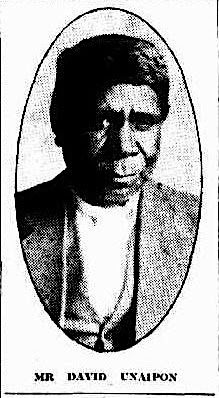
INVENTOR AND STUDENT ABORIGINE ATTRACTS Mr. David Unalpon, the Australian
aborigine from the Point Macleay Mission Station, South Australia, whose photograph Is here, produced, Is on a visit to Melbourne.Herald. (Melbourne, Vic. : 1861 - 1954), Monday 13 July 1914
David Unaipon, the man on our $50 note, was the first Aboriginal author to be published in the 1927, when his book of Aboriginal legends was published

However, according to the South Australian Museum historian, Unaipon ".. signed a book contract with Angus & Robertson, but they baulked at his blend of fairy tale, popular science, Aboriginal legend and Christian morality." (1.)

Angus and Robertson then sold the copyright of the stories to William Ramsay Smith.

In 1929, William Ramsay Smith published Myths & legends of the Australian Aboriginals (1930), as told to Smith by David Unaipon, who was Smith's assistant.
  
Later research showed that Unaipon had sold the text to finance his own work. (Volume 85 Item 2: Angus & Robertson correspondence files from Lilian Irene Turner to Arthur Styles Vallack, 1896–1931)

David Ngunaitponi, known as David Unaipon (1872-1967), was born on 28 September 1872 at the Point McLeay Mission, South Australia, a member of the Ngarrindjeri people, where he was introduced to popular science by his teacher, Walter Hutley.
Kapunda Herald (SA : 1878 - 1951), Tuesday 22 May 1894
Unaipon left school at 13 to work for C.B. Young, patron of the Aborigines’ Friends’ Association, who encouraged Unaipon's interest in literature, philosophy, science and music.

From 1924 onwards, Unaipon wrote many articles for the Sydney Daily Telegraph.

Unaipon defied stereotypes in many ways. Described as urbane and self-possessed, he had a formal manner, was very particular with his use of language and was cultured and dignified.

He was also an inventor, evangelical preacher, political activist, orator and singer. 

Unaipon also assisted various inquiries and commissions into Aboriginal welfare and treatment.
Dungog Chronicle : Durham and Gloucester Advertiser (NSW : 1894 - 1954), Friday 23 November 1923
DAVID UNAIPON, Adelaide's best known native, demonstrates how to throw a boomerang. He spends much time in the parklands teaching schoolchlldren the art. He thinks boomerang throwing should he a national sport. Barrier Miner (Broken Hill, NSW : 1888 - 1954), Saturday 1 October 1932
News (Adelaide, SA : 1923 - 1954), Friday 21 May 1937
News (Adelaide, SA : 1923 - 1954), Saturday 13 June 1953


Star Trek and Captain Cook

Captain Kirk of Star Trek is based on Captain James Cook, the explorer. Furthermore, the USS Enterprise was named after Cook's ship, the...